Fixed-Rate Cash ISA Switch Calculator
Is it worth paying a penalty to leave a fixed-rate cash ISA for a better rate? Compare both routes.
- No sign up
- UK focused
- Results are estimates only
Not financial advice.
Correct as of . The ISA and tax rules on this page were last checked against gov.uk on this date. Figures are for the 2026/27 tax year unless a different year is stated. For every rule with its source, see ISA rules at a glance.
Many fixed-rate cash ISAs charge an early access penalty, often a number of days' interest, if you leave before the end of the term. Enter your balance, your current rate, how long is left on the fix, the penalty and the rate you could get elsewhere. The calculator compares where each route leaves you on the date your current fix would have ended, and shows the new rate you would need to break even.
Fixed-Rate ISA Switch Calculator
If you stay: value at the end of the fix
If you switch: value at the same date
Estimated penalty
Figures are rounded to the nearest pound. Illustrative only: check the penalty and interest terms with your provider. Not financial advice.
This assumes both rates stay fixed and interest is added monthly. Providers work out penalties and pay interest in different ways, so check your account terms.
Advanced ISA Planner
Compare ISA scenarios side by side
£14.99 one-off, no subscription
For further ISA saving, the Advanced ISA Planner can set cash ISA saving alongside other ISA types across several tax years.
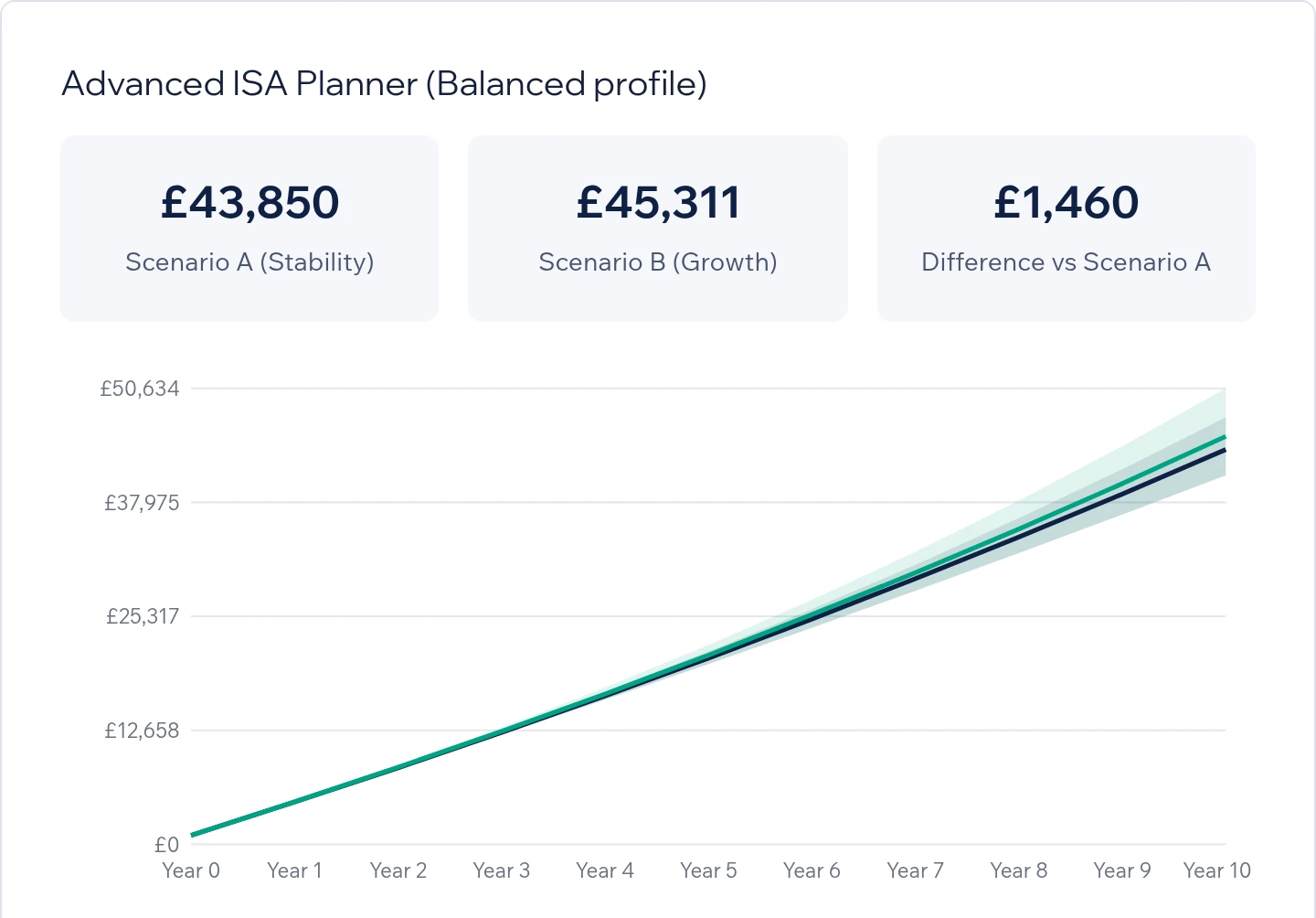
When a single calculator is not enough, the Advanced ISA Planner lets you set up longer-term scenarios, combine different ISA types, including cash ISAs, and model multiple tax years in one place.
- Combine Cash and Stocks & Shares ISAs
- Model multiple tax years and allowances
- Adjust returns, contributions, and time horizons
- Compare scenarios side by side
A paid tool: a one-off purchase of £14.99, with no subscription. The free calculators are separate from the planner. See the refund policy. Figures are illustrations, not forecasts.
How does the comparison work?
- Stay: your balance grows at your current fixed rate until the fix ends.
- Switch: the penalty is taken off first (days of interest at your current rate on your balance), then the rest grows at the new rate for the same number of months.
- Break-even rate: the new rate at which both routes end level. A new rate above it comes out ahead in this scenario; below it, staying comes out ahead.
The comparison stops when your current fix would have ended. If the new account fixes for longer, what happens after that date is not included.
How does moving a fixed-rate ISA by transfer work?
To keep your savings tax-free, ask the new provider to transfer your ISA. gov.uk explains that if you withdraw the money instead, you will not be able to reinvest that part of your tax-free allowance again: paying it into a new ISA would count as a new payment within your £20,000 allowance for 2026/27. gov.uk says transfers between cash ISAs should take no longer than 15 working days, and other transfers no longer than 30 calendar days.
Our guide to ISA transfers explains the process step by step.
What can the calculator not know?
- Whether your provider allows early transfer out of the fix at all, and exactly how it works out the penalty.
- Whether interest is paid monthly or yearly, and whether the new rate is fixed or variable.
- Rates available when your current fix ends, which could be higher or lower than today.
Cash ISA rules are also changing: see the guide to the cash ISA changes.
Frequently asked questions
What does the fixed-rate ISA switch calculator compare?
It compares two routes to the date your current fix would have ended. If you stay, your balance grows at your current fixed rate. If you switch, the penalty is taken off first (days of interest at your current rate on your balance), then the rest grows at the new rate for the same number of months.
What is the break-even rate?
It is the new rate at which both routes end level. In the scenario you enter, a new rate above it comes out ahead and a rate below it leaves staying ahead.
What does the calculator not know?
It cannot know whether your provider allows an early transfer out of the fix at all, or exactly how it works out the penalty. It does not know whether interest is paid monthly or yearly, whether the new rate is fixed or variable, or what rates will be available when your current fix ends. It also stops at the date your current fix would have ended, so anything after that date is not included. Check your account terms.
What does gov.uk say about transferring or withdrawing?
gov.uk says that if you withdraw the money instead of transferring it, you will not be able to reinvest that part of your tax-free allowance again. Paying it into a new ISA would therefore be a new payment within the overall allowance (£20,000 for 2026/27). gov.uk says transfers between cash ISAs should take no longer than 15 working days, and other transfers no longer than 30 calendar days. Our guide to ISA transfers explains the process.
Does the calculator say whether I should switch?
No. It shows the arithmetic for the figures you enter: your balance, both rates, the time left on the fix and the penalty. Whether a switch suits you depends on your own circumstances and your account terms. The calculator gives general information only, not financial advice and not a recommendation of any product or provider.
Related guides and tools
Sources
This calculator gives general information only. It is not financial advice or a recommendation of any product or provider.